
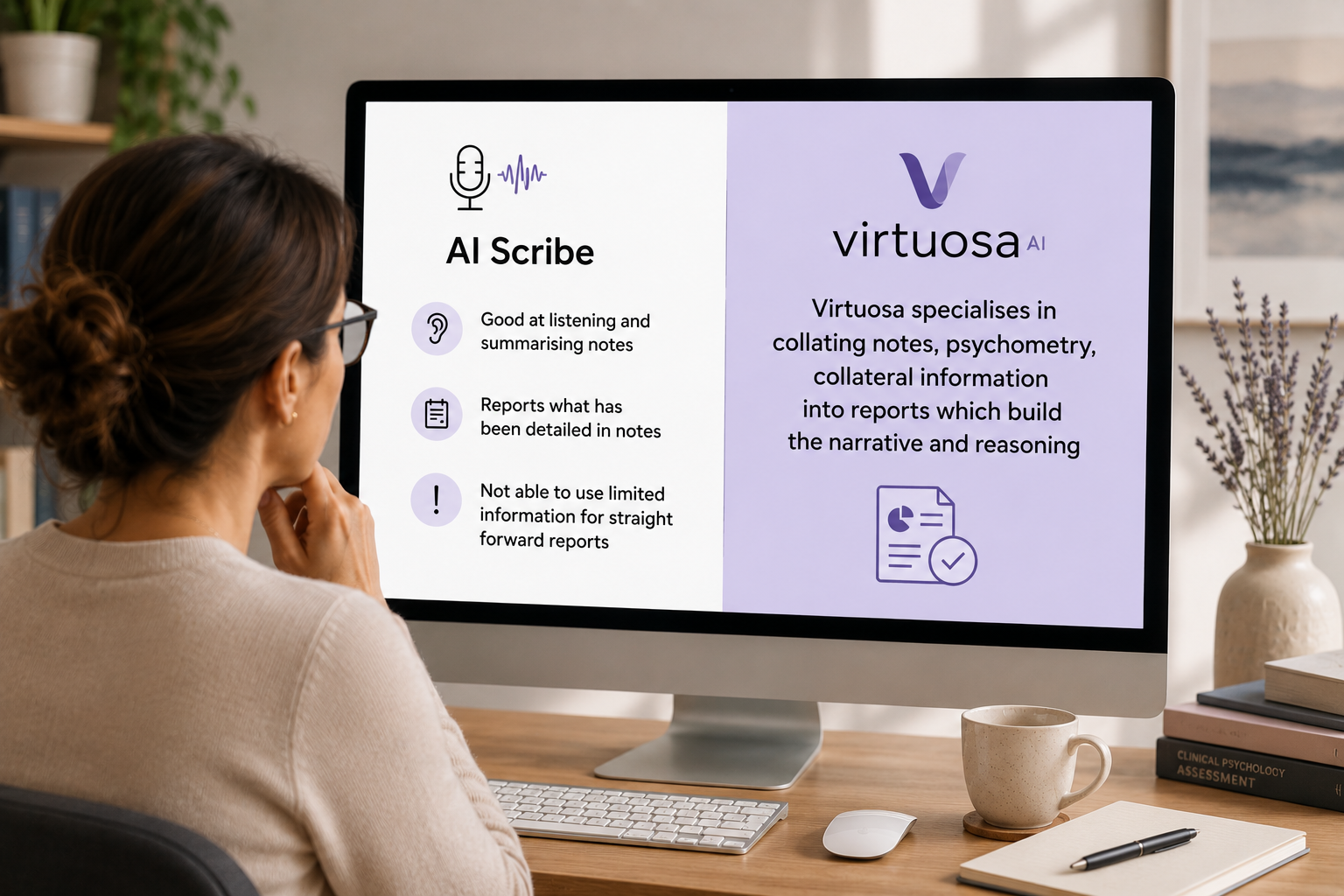
An AI scribe can write a report. So why would a psychologist need a dedicated report-writing application?
It's a fair question, and one we get asked often. It also deserves a more honest answer than the one usually given. Let's start by being accurate about what scribes can do
There's a lazy version of this argument that goes: scribes only listen to sessions, so they can only write session notes. That was true a while ago. It isn't true now, and any psychologist who has used a good scribe recently will know it.
The better AI scribe platforms have moved well past transcription. Depending on the product, they can: generate letters, treatment summaries, discharge letters and structured assessment reports, not just progress notes offer templates for specific document types, including workers compensation and insurer forms, NDIS reports and assessment reports pull psychometric results directly into a document, including where a measure has been administered more than once accept uploaded documents such as referrals, correspondence and prior reports, and use them in what they generate
The real difference sits somewhere less obvious. It's about how much information the tool can hold, how long it holds it for, and what it does with it when the document you need is genuinely complex.
Difference one: attachments versus a case file
Most scribe platforms work on an attach-at-generation model. When you produce a document, you select the relevant psychometrics, tick the notes you want, attach a few files, and generate.
That works well, and for a large share of clinical documentation it's exactly right.
It starts to strain when the file gets big.
Attachment limits are real, they vary between products, and they change — so check the current specifications of whatever you use rather than trusting anything you read in a blog post, including this one. But the pattern is consistent: there's a limit on how many documents you can attach in one go, and a cap on the size of each.
Now think about a medico-legal brief. Or a workers compensation file that has been running for three years. Or an assessment where the school reports, the paediatrician's letters, the previous cognitive assessment, the parent and teacher rating scales and the insurer's correspondence all matter.
That isn't five documents. And you don't want to re-select them every time you write something.
A dedicated report-writing application is built around a persistent body of client context rather than a per-document attachment step. The file lives in one place, accumulates over time, and is available to every report you write about that person.
Difference two: templates versus report architecture
A template is a shape. It tells the AI what headings to use and roughly what belongs under each. That's genuinely useful, and both categories of tool offer templates.
But a complex report isn't only a shape. A workers compensation progress report has to actually answer the questions the insurer asked, using evidence drawn from across the treatment period, and it has to distinguish between what you observed, what the client reported, what a measure showed and what you concluded from all of it.
The report type determines not just the headings, but which information is relevant, how it should be weighted, what evidence needs to be cited under each heading and what the document is required to demonstrate.
Building for that is a different engineering problem to filling in a template well. It's the difference between a form and a framework.
Difference three: the report isn't a summary of the last session
Imagine a psychologist is asked to write a workers compensation progress report. The relevant information might be scattered across six months of treatment. There may have been changes in symptoms. Psychometric scores may have improved, deteriorated or fluctuated. The psychologist may have documented barriers to recovery several months earlier. There may be information from the employer, insurer, GP or psychiatrist. Work capacity may have changed. Treatment goals may have evolved.
The psychologist isn't really asking:
"What happened in today's session?"
They're asking:
"What does all of the information I have about this person tell me about their progress over time, and what is relevant to the question I have been asked to address?"
Getting a set of scores into a document is one task. Working out what those scores mean across four administration dates, alongside a change in duties in month three and a documented flare after a return-to-work meeting, is a different one.
When writing about treatment progress, the most useful information often doesn't come from the most recent appointment at all. It may be something documented three months earlier, combined with psychometric results from several different dates and a line in the employer's correspondence.
That's where longitudinal reasoning matters, as distinct from longitudinal access.
Now consider a neuropsychological report, a comprehensive ADHD or autism assessment, a three-year workers compensation file, a medico-legal opinion, or a response to a referral question with eight specific parts.
At that point the AI needs to work across many documents, many sessions, multiple psychometric administrations, history, collateral information, clinical observations and the specific requirements of that report type — simultaneously, and with the reasoning holding together across forty pages. The challenge is no longer generating text. It's holding the whole file in view and knowing what belongs where.
That's the problem Virtuosa AI was built for.
Why we built Virtuosa differently
Virtuosa AI was designed from the start as a report-writing application for psychologists, rather than as a scribe that later added report templates. The psychologist builds a body of clinical context around the client — session notes, psychometrics, symptoms, diagnoses, collateral information, general clinical information and relevant documents — and that context persists. Every report written about that client can draw on it.
Virtuosa then generates sections of a report against the requirements of that report type, working from those sources rather than predominantly from one consultation or one set of attachments.
It's a narrower product than a scribe. That's deliberate. We'd rather be the best option for the report that's been sitting in your drafts folder for a fortnight than an adequate option for everything.
The psychologist still does the psychology
This distinction matters just as much.
A dedicated report-writing application shouldn't be replacing the psychologist's clinical judgement.
The goal isn't: give the AI a client and let it decide what you think.
The goal is: help the psychologist work with the information they already have, so they can communicate their clinical thinking more efficiently and more clearly.
The psychologist remains responsible for reviewing, editing and approving the report. The AI handles more of the information-management and drafting burden. The clinician remains responsible for the clinical reasoning, and accountable for the final document.
So do psychologists need both?
Quite possibly.
I don't think the future is a battle between AI scribes and AI report writers. They sit at different points in the documentation workflow, and plenty of practices will run both without any conflict : the scribe for the day-to-day, the report-writing application for the reports that take a lot of time.
Eventually those workflows are likely to become more connected. That's probably where things get really interesting.
Because the real opportunity for AI in psychology isn't simply getting it to type faster. I t's helping psychologists spend less time searching through information, reorganising material and staring at a half-written report - and more time doing the part that actually requires a psychologist.
Thinking
Frequently asked questions:
Can an AI scribe write a psychology report?
Yes. Modern scribe platforms offer templates for letters, treatment summaries, insurer forms, NDIS reports and assessment reports, and many can incorporate psychometric results and uploaded documents. Where they're less suited is very large, long-running or multi-source files, where the volume of material exceeds what you can practically attach to a single generation and the reasoning has to hold across a long, structured document.
What is the difference between an AI scribe and AI report-writing software?
Both can produce reports. The difference is architectural. A scribe is built around the clinical encounter and assembles context at the point of generation. A report-writing application is built around the report, maintains a persistent body of client information over time, and is designed for the requirements of specific complex report types.
Do AI scribes handle psychometric results?
Many do, and some do it very well — including drawing on multiple administrations of the same measure. The question worth asking isn't whether a tool can insert scores, but how well it interprets change across administrations and integrates that with everything else in the file. Do I need both an AI scribe and a report-writing application?
Many psychologists will use both. If most of your documentation is progress notes and short letters, a scribe may be all you need. If a meaningful part of your week disappears into complex reports, a dedicated report-writing application is likely to make more difference.
Is AI-assisted report writing appropriate for medico-legal and workers compensation reports?
These are high-stakes documents, so the standards are higher: the clinician must review, edit and approve everything, the clinical reasoning must remain their own, and privacy and data handling must be sound. Requirements around disclosing AI use differ by jurisdiction and by forum, so check the current expectations that apply to your reports. Used properly, AI can reduce the information-management burden without displacing the clinician's judgement or accountability.
Does using AI mean the psychologist is no longer responsible for the report?
No. The psychologist remains responsible for the content, the clinical reasoning and the final approval. A report-writing application produces a structured first draft; it does not form clinical opinions on your behalf.